




































From Wallet Activity to Tax Liability

Suyash Singh, Product Manager, Analytics
Turning Blockchain Data into Evidence
The rapid growth of digital assets has created a new challenge for tax authorities worldwide: ensuring crypto tax compliance in a financial system built without traditional intermediaries.
Unlike banks or financial institutions, blockchain networks operate on decentralized infrastructure where transactions occur directly between wallet addresses. As cryptocurrencies move across exchanges, decentralized finance (DeFi) platforms, NFT marketplaces, and cross-chain networks, significant economic activity can occur outside traditional reporting systems.
Yet every blockchain transaction leaves a permanent trail.
Millions of transactions occur daily across public blockchains, creating a transparent and immutable ledger of digital asset activity. In theory, this transparency should make tax enforcement easier.
In practice, however, raw blockchain data is rarely usable as tax evidence.
A blockchain ledger records transfers between cryptographic addresses, not taxpayers. Transactions appear as long strings of hashes, wallet identifiers, and token movements. For tax authorities and investigative agencies, the challenge is not the absence of data but the conversion of blockchain activity into legally defensible tax intelligence.
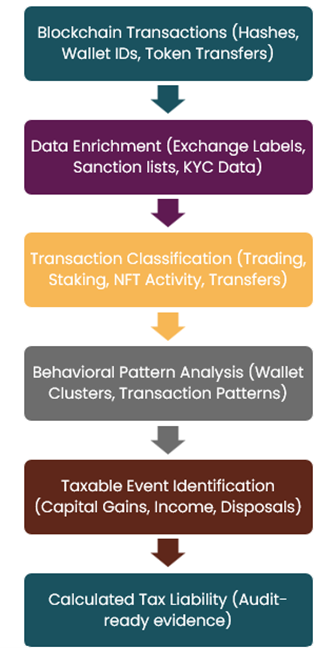
Turning wallet activity into tax liability requires a structured analytical process: enrichment, classification, and validation.
The Gap Between Blockchain Data and Tax Enforcement
Public blockchains such as Bitcoin and Ethereum provide complete transaction histories. Every transfer, wallet interaction, and smart contract execution is recorded immutably.
However, for regulators conducting digital asset investigations, this data presents several operational challenges:
- Pseudonymity: Wallet addresses do not inherently identify taxpayers
- Volume and complexity: Large investigations may involve thousands of wallets and millions of transactions
- Cross-platform activity: Transactions occur across exchanges, DeFi protocols, NFT markets, and cross-chain bridges
- Evidentiary standards: Data used in enforcement must be auditable and legally defensible
Without specialized blockchain analytics for tax authorities, investigators are left with raw ledger data that is difficult to interpret and nearly impossible to translate into clear tax obligations.
To bridge this gap, blockchain transactions must undergo a transformation process that converts raw activity into structured investigative evidence.
Step 1: Data Enrichment – Giving Context to Wallet Activity
The first step in converting blockchain data into actionable intelligence is data enrichment.
Enrichment attaches context to otherwise anonymous wallet addresses and transactions. This process typically involves integrating blockchain data with multiple external datasets, including:
- Known exchange and digital asset service provider wallets
- Sanctions and risk databases
- Darknet and illicit marketplace identifiers
- Public blockchain labeling datasets
- Off-chain metadata such as exchange records or KYC information
Through enrichment, previously opaque wallet activity becomes interpretable. For example, what appears as a sequence of anonymous transactions may reveal:
- Deposits to centralized exchanges
- Transfers through mixing services
- DeFi trading activity
- NFT purchases or sales
This contextualization is essential for blockchain tax enforcement, because it allows investigators to understand the economic meaning behind blockchain transactions. Without this layer of intelligence, it becomes difficult to determine whether wallet activity represents taxable events such as capital gains, income, or asset transfers.
Step 2: Transaction Classification – Identifying Taxable Events
Once transactions are enriched with contextual data, the next step is transaction classification.
Blockchain ecosystems support many different transaction types, each with distinct tax implications. A single wallet may engage in activities such as:
- Trading cryptocurrencies
- Bridging assets across chains
- Staking or liquidity provision
- NFT purchases and sales
- Token airdrops or rewards
Each of these activities can generate different taxable events depending on jurisdictional tax rules. Advanced blockchain analytics classify transactions into meaningful categories such as:
- Asset disposals
- Income events
- Token swaps
- Liquidity pool interactions
- Transfers between controlled wallets
Classification allows investigators to move beyond individual transactions and begin reconstructing complete taxpayer activity profiles. For tax authorities conducting crypto tax investigations, this is the stage where blockchain data begins to translate into potential tax liabilities.
Step 3: Validation – Building Legally Defensible Evidence
For tax regulators and investigative agencies, identifying suspicious activity is only part of the process. Evidence used in enforcement must withstand legal scrutiny. This is where validation becomes critical.
Validation ensures that analytical conclusions are transparent, traceable, and auditable. Key elements include:
- Transaction traceability: Linking conclusions back to specific blockchain transactions
- Audit trails: Documenting each analytical step used in the investigation
- Methodological transparency: Ensuring classification models and enrichment sources are explainable
- Reproducibility: Enabling investigators or courts to independently verify findings
When properly validated, blockchain analysis can produce evidence that meets the standards required for audits, enforcement actions, and litigation.
The result is a defensible chain of reasoning that connects:

Case Example: Blockchain Analytics in U.S. Tax Enforcement
The United States has been one of the most active jurisdictions in applying blockchain analytics to strengthen digital asset tax compliance. The Internal Revenue Service (IRS), particularly through its Criminal Investigation division (IRS-CI), has developed specialized capabilities to trace blockchain transactions and identify taxpayers attempting to conceal cryptocurrency income.
One of the earliest examples was the 2016 investigation into Coinbase, where the IRS issued a “John Doe” summons seeking records of U.S. customers who had conducted cryptocurrency transactions. The investigation ultimately led to the identification of thousands of taxpayers who had not properly reported crypto-related income.
Since then, the IRS has expanded its digital asset enforcement capabilities and incorporated blockchain tracing into broader tax investigations. According to the IRS Criminal Investigation division, cryptocurrency tracing has become an important tool in identifying tax evasion and financial crimes involving digital assets.
This example demonstrates how blockchain transaction data - when enriched, classified, and validated - can be transformed from anonymous wallet activity into evidence supporting real-world tax enforcement.
From Blockchain Transparency to Enforcement Capability
Blockchain technology has introduced an unprecedented level of financial transparency. Every digital asset transaction is permanently recorded on a public ledger.
However, transparency alone does not automatically translate into effective tax enforcement.
For regulators seeking to strengthen crypto tax compliance, the real challenge lies in operationalizing blockchain data - transforming massive volumes of decentralized transaction data into clear investigative insights and legally defensible evidence.
This requires capabilities such as:
- Processing blockchain data at investigative scale
- Enriching wallet activity with contextual intelligence
- Classifying complex digital asset transactions
- Generating audit-ready investigative outputs
As digital asset adoption continues to expand globally, tax authorities will increasingly require tools that can transform blockchain data into actionable tax intelligence.
Archon Insights, developed by mLogica, is designed to support this process by enabling tax authorities and investigative agencies to convert blockchain activity into structured analytical outputs suitable for regulatory investigations and enforcement.
By bridging the gap between blockchain transparency and tax compliance enforcement, platforms like Archon Insights help regulators turn raw wallet activity into something far more powerful: evidence.
Sources
- IRS Criminal Investigation Annual Report (2023)
- U.S. Department of Justice - Coinbase John Doe Summons Case
Contact
Turn raw blockchain data into audit-ready evidence. Contact us to request an Archon Insights Demo today.
Suyash Singh, Product Manager, Analytics
- Share on