




































From Black-Box Scores to Defensible Decisions: How the Inference Data Layer Brings Governed AI to Archon Insights
George Petrovic – Product Owner, Platform Strategy & Digital Assets
Every blockchain analytics vendor now markets Far fewer can answer the questions that follow the moment an AI-assisted alert reaches as supervisor, an auditor, a regulator, or a courtroom: Why did the model flag this wallet? What data was it trained on? Which version of the model made the call? Is it still performing the way it did on the day it was approved?
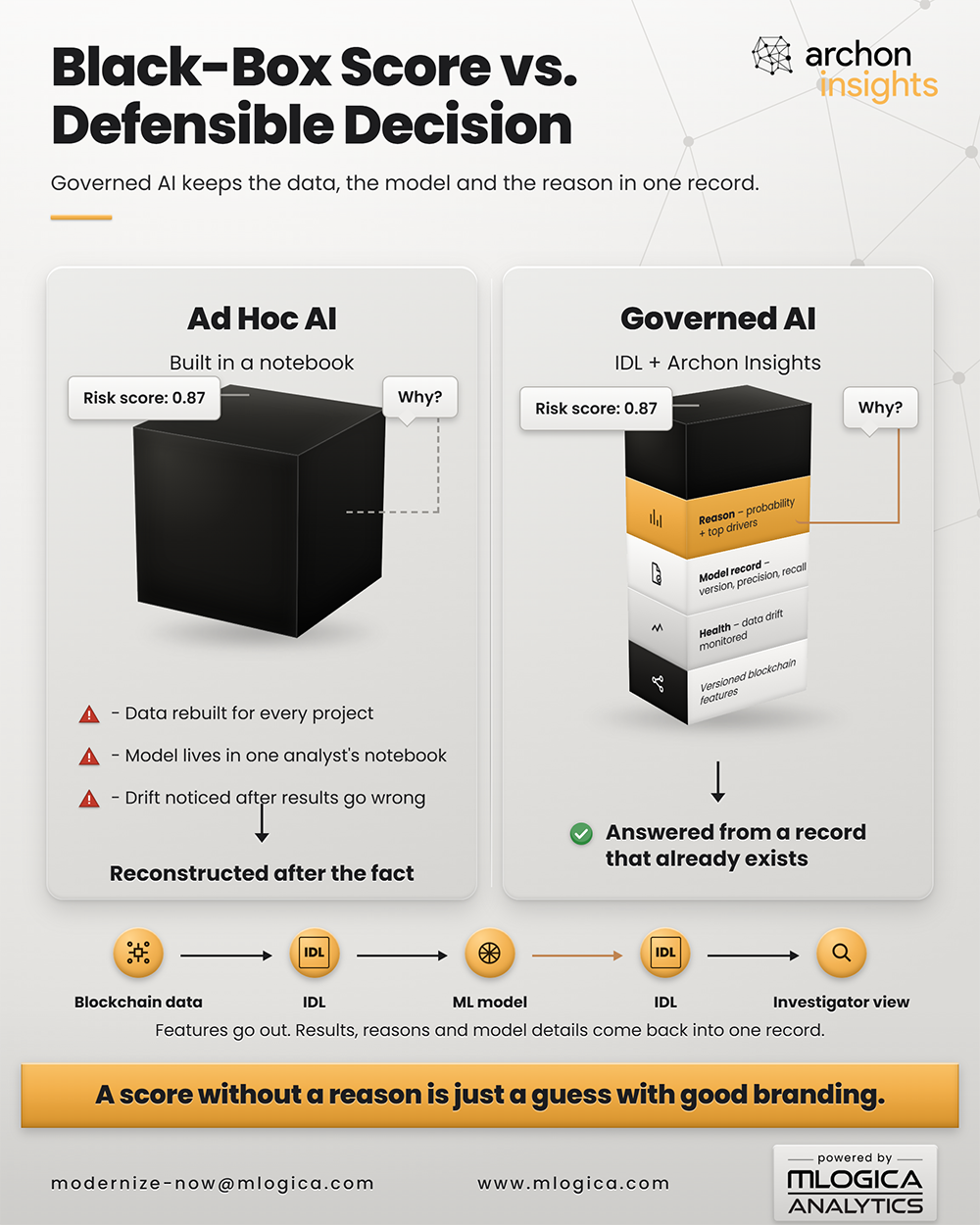
If the honest answer is “we would have to ask the data scientist,” the model is not an operating asset. It is an exposure. The Inference Data Layer (IDL) exists to close that gap. It keeps the data, the model, and the result together so the people who investigate crypto activity can see—and later reconstruct—what the model actually used. and Archon Insights is where that governed intelligence meets the people who do this work every day.
The Problem With “Trust the Model”
Most financial institutions, exchanges, and payment providers already run some form of machine learning in their compliance work. It usually grows the same way: one team builds a risk model, another builds a classifier, and each one pulls, cleans, and reshapes its own data from scratch. The results sit in separate environments, disconnected from any system of record.
That creates three practical problems:
- Wasted effort. Data scientists spend most of their time finding and preparing data rather than building better models.
- No shared memory. Features built for one model are rarely reused for the next, so the same work is repeated.
- No defensible trail. When a model’s output is challenged, there is no single place that shows the data, the model and the decision together.
What IDL Is and What It Isn’t
IDL is a vendor-neutral layer that sits underneath machine learning initiatives, not inside the model. It does not replace the tools your data scientists already use. It takes ownership of feature engineering and data management — the work every model depends on. Training and inference stay exactly where they are today, in the organization’s own ML environment.
Two points matter for anyone evaluating it. First, IDL does not make predictions. It supplies data to models and captures what they produce. The model is always responsible for the inference. Second, IDL is not just a feature store. A feature store versions and serves inputs. IDL does that and also keeps a governed record of the model, the data, and the decision together, then sends the results back into the analytical environment people already use.
How It Works: Two Directions, One Record
1. Feeding the models
IDL maintains a ready-made catalog of structural and behavioral features about the entities that matter. In blockchain, those are addresses and transactions. Features can be raw (taken straight from the ledger), processed, derived across time or across groups of entities, sourced externally, or inferred by earlier models. Every feature is uniquely identified and versioned, so a data scientist selects what a model needs instead of rebuilding it.
2. Catching what comes back
When a model returns a result, IDL captures far more than the answer itself:
- The inference: the predicted outcome for a specific address or transaction.
- Inference metrics: the probability behind it and the features that pushed the result up or down, using SHAP, an explainability method that attributes each prediction to its inputs.
- Model details: parameters, version, and performance metrics such as precision and recall.
- Health signals: whether incoming data is drifting away from what the model was trained on.
IDL then splits this into a shared set, the plain-language result business users need, and an internal set, the full technical detail kept for audit and troubleshooting.
Where Archon Insights Comes In
IDL’s architecture is domain-agnostic. Its value in a given industry depends on having a well-defined domain and features engineered by people who understand it. That is what Archon Insights contributes.
Archon Insights brings the blockchain domain: engineered address and transaction features that describe how funds actually move, and the investigation environment compliance teams already use. With IDL underneath, an AI result does not arrive as a separate report. It is designed to return to the investigator in context, at the level of detail they choose, from a minimal label to a detailed breakdown of what drove it.
An illustration of how this plays out. A compliance analyst is reviewing an address that has surfaced during monitoring. A classification model, trained on features supplied through IDL, has estimated what type of address it is. Instead of a bare label, the analyst sees the probability behind it and the handful of behavioral features that weighed most heavily, such as patterns in incoming transaction activity. If a senior reviewer or examiner later asks why the address was escalated, the answer already exists: which model version made the call, what data it used, and how that model was performing at the time.
Ad Hoc AI vs. Governed AI
| AD HOC (Notebook-built) AI | Governed AI (IDL + Archon Insights) | |
|---|---|---|
| Input data | Pulled and cleaned per project; features live in the author’s environment | Pre-built, versioned blockchain features, selected for the model and reused across models |
| Lineage | Rerunning a model depends on the original notebook and machine | Each result is tied to the model version and the feature set used at inference time |
| Model record | Spread across personal environments and files | Parameters, versions and metrics in one governed repository |
| Promotion to production | Informal; often the builder deploys it | Role-based review and approval before any model goes live |
| Explainability | Present if the data scientist added it | Each result ships with a score and its top contributing features |
| Data drift | Checked manually, if at all | Monitored continuously, stored as time series, and alerted when thresholds are crossed |
| Where results land | A file, a notebook, or a separate report | Back in Archon Insights, on the address or case the investigator is already working |
| When an auditor asks "why?" | Reconstructed after the fact, if at all | Answered from a record created at inference time: model version, features used, and how the model was performing then |
Why It Matters to the Business
This is not an architecture story. It is a risk story. For compliance leaders, governed AI means:
- Validated before go-live. Models are reviewed and governed before they reach production, not investigated only after something breaks.
- Faster investigations. Analysts can prioritize by probability instead of working every alert the same way.
- Consistent, defensible conclusions. The audit trail is generated as the work happens, not reconstructed under pressure.
- Knowledge that compounds. Features and model history stay with the organization, not with one analyst or one tool.
Getting started does not require a large transformation project. The approach begins with the intelligence a team already has and proves value on one or two priority use cases before expanding.
The Bottom Line
AI will increasingly shape which crypto transactions get cleared, escalated or reported. The institutions that benefit will not be the ones with the most models. They will be the ones that can explain every decision those models influence.
A score without a reason is just a guess with good branding.
Want to see how IDL and Archon Insights fit together? Get in touch to receive the IDL two-pager and supporting reading material.
George Petrovic – Product Owner, Platform Strategy & Digital Assets
- Share on