








































Catching the Invisible AI flags Tax Evasion patterns as they happen

Ketan Karia – VP, Analytics EMEA
Tax authorities worldwide are deploying artificial intelligence and behavioural analytics to uncover indirect tax evasion at a scale impossible just a few years ago. The shift from periodic manual audits to continuous, data-driven is delivering striking results — but also raising important questions about transparency, accuracy, and due process.
The Scale of the Problem
Indirect taxes such as VAT and GST form a major part of government revenue, yet evasion remains widespread. Carousel fraud, invoice manipulation, and underreported cash sales cost treasuries tens of billions annually. Traditional audit methods which include random sampling, tip-offs, and physical inspections, simply cannot keep pace with the volume and velocity of modern digital commerce.
The emergence of e-commerce has compounded the challenge. Cross-border transactions, pseudonymous buyers, and high-frequency micro-payments create opportunities for sophisticated evasion schemes that evade conventional detection. In response, authorities have responded by investing heavily in technology that analyzes vast datasets, identifies anomalies, and flags suspicious behaviour in real time. This articles examines the key techniques powering these systems and the real-world results they are achieving.
Core Techniques in AI-Driven Detection
Predictive Risk Scoring
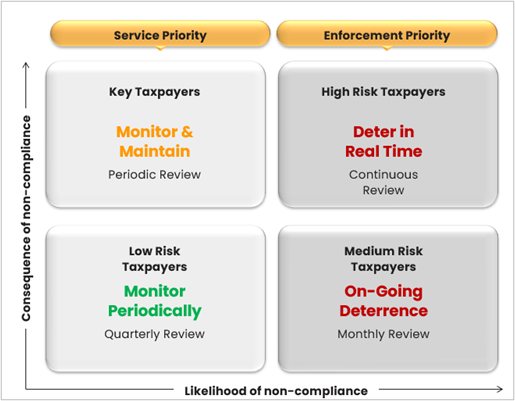
Machine learning classifiers are trained on historical audit outcomes to assign risk scores to taxpayers. These models ingest hundreds of features: filing patterns, input-output ratios, supplier networks, payment velocities, and geographic indicators and even revenue impact to the economy. The groupings are selected by probabilities that a given entity is engaged or likely to engage in non-compliance, allowing auditors to prioritise high-risk cases while algorithms monitor lower risk groups for anomalies.
Anomaly Detection
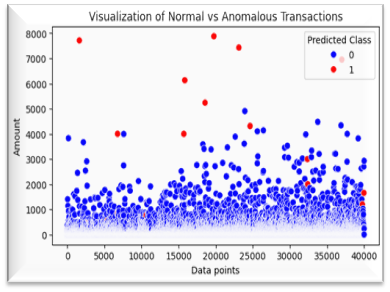
Automated methods such as Isolation Forest and deep auto-encoders identify outliers without requiring labelled examples of fraud.
An auto-encoder learns the “normal” pattern of compliant transactions; any record that reconstructs poorly is flagged for review. This approach is especially valuable because evasion tactics evolve rapidly and labelled fraud datasets remain scarce.
Network and Graph Analysis
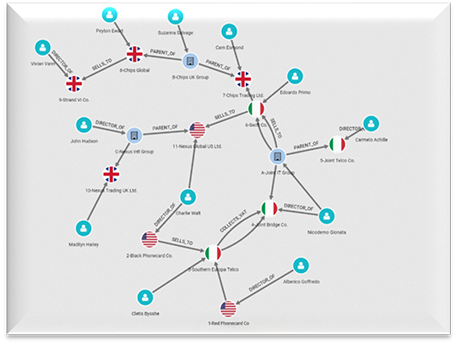
VAT fraud often involves chains of fictitious invoices passing through shell companies. Graph algorithms map supplier-buyer relationships and detect circular flows, unusually dense clusters, or entities that appear only briefly before disappearing. When combined with temporal analysis, these techniques can trace carousel schemes across multiple jurisdictions.
Behavioural Analytics
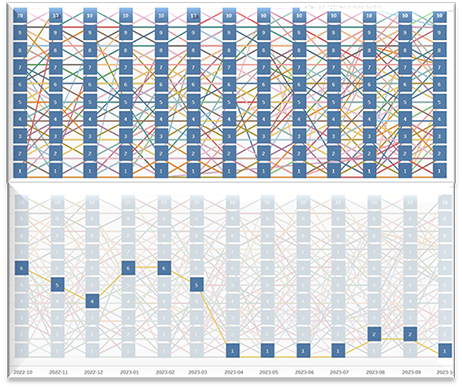
Beyond transactional data, authorities now analyze behavioural signals:
filing timing, sudden changes in declared turnover versus industry benchmarks, or mismatches between web traffic and reported sales.
Behavioural models look for intent indicators—such as repeated last-minute amendments or systematic rounding of figures—that suggest deliberate manipulation rather than error.
Real-World Deployments and Results
Serbia’s e-Fiscalization Project
In a bid to reduce the grey economy, Serbian Tax Administration launched their e-fiscaization project which mandated the replacement of old cash-based registers with certified electronic fiscal devices designed to transmit transaction data directly to tax authority systems in real-time. The registers generate fiscal receipts with QR codes so consumers can verify their purchases.
Since becoming mandatory in January 2022, the system, designed by mLogica, processes over 10 million transactions daily and has generated dramatic results. Serbia’s new VAT tax revenue has increased by 14% in real terms and official government reports indicate that 70% of their goals for tackling the grey economy have been met. In 2023 mLogica’s Fraud Management systems, used machine learning and AI techniques to identify 8,640 non-compliant taxpayers with accompanying evidence. It resulted in targeted, data driven field audits, improving both enforcement efficiency and audit/recovery ratios to over 60%. The STA reports that VAT now forms the largest portion of net new tax revenues.
In 2025 the World Bank approved an additional €27 M to further digitise taxation in Serbia.
India's Project Insight and ADVAIT
India's tax administration has built one of the most ambitious AI surveillance systems in the world. Project Insight, launched by the Central Board of Direct Taxes, integrates financial data with third-party sources, including social media to construct 360-degree taxpayer profiles. The Central Board of Indirect Taxes followed with Project ADVAIT (Advanced Analytics in Indirect Taxation) in 2021 to target GST and customs evasion.
The results have been dramatic. In early 2026, authorities analysed 60 terabytes of billing data from cloud-based point-of-sale systems and uncovered an estimated ₹70,000 crore (roughly $8 billion) in suppressed restaurant turnover. AI tools reconstructed deleted invoices by tracing timestamps, server logs, and edit histories—evidence that would have been invisible to traditional audits. freepressjournal.in Between April and December 2023, ADVAIT and related tools registered nearly 14,600 GST evasion cases; in one instance, the system identified ₹11,000 crore in IGST fraud among just 24 large importers. thesquirrels.in
Italy's Data-Driven Transformation
The Italian Revenue Administration (Agenzia delle Entrate) has partnered with the European Commission to deploy predictive AI and machine learning across its risk-analysis processes. The initiative targets carousel fraud and cross-border VAT abuse. Early reports indicate that algorithmically guided audits recover up to 38 percent more evaded tax than traditional methods. globalindirecttaxmanagement.com
Broader European and UK Experience
The United Kingdom's HMRC Connect system, which inspired India's Project Insight, cost approximately £100 million to develop and has prevented an estimated £4.1 billion in tax losses by correlating data across banking, property, and commercial registers. Similar platforms are emerging across the EU as member states implement mandatory e-invoicing and real-time reporting, feeding ever-larger datasets into centralised analytics engines.
Balancing Efficiency with Fairness
AI-driven enforcement is undeniably effective, but it introduces new risks. Algorithms trained on historical data may encode biases or generate false positives that burden compliant businesses. In India, critics note that the system operates as a "black box"—taxpayers flagged by the algorithm often face frozen bank accounts and blocked input-tax credits before they can understand, let alone contest, the underlying reasoning. thesquirrels.in
Interpretability tools such as SHAP and LIME are increasingly integrated into enforcement pipelines to provide feature-level explanations for flagged transactions. These methods help auditors distinguish genuine evasion from anomalies caused by legitimate business complexity offering taxpayers a clearer basis for appeal.
Governance frameworks continue to lag behind the technology. India's Digital Personal Data Protection Act, for instance, contains broad exemptions for government processing and no requirement for algorithmic impact assessments. Legal scholars argue that robust safeguards should include audit logs, statutory appeal mechanisms, and independent oversight bodies must accompany any expansion of automated enforcement.
The Road Ahead
The trajectory is clear: tax authorities will continue to expand their use of AI, behavioural analytics, and real-time data matching. Mandatory e-invoicing regimes in jurisdictions from France to Saudi Arabia will generate streams of structured data ideally suited for machine analysis. The question is whether governments can pair technological power with proportionate oversight, ensuring that the efficiency gains of algorithmic enforcement do not come at the cost of transparency, due process, and taxpayer trust.
Give your business the Intelligence Edge.
As ever evolving and sophisticated evasion tactics continue to feed VAT gaps around the world, compounded by ever stretched government resources, what is your government doing to fight back?
Contact us today to see how our AI-powered analytics can help you level the playing field: detecting anomalies in real time, revealing hidden fraud patterns, and delivering predictive risk insights so you can safeguard your revenue and maintain strong VAT compliance.
Ketan Karia – VP, Analytics EMEA
- Share on