










































Real-Time Blockchain Monitoring vs Post-Facto Crypto Audits: Why Tax Authorities Cannot Afford to Look Backwards

Suyash Singh – Product Manager - Analytics Solutions
Crypto is no longer a niche asset class. In 2025, an estimated 741 million people held cryptocurrency, up more than 12% in a single year. The IMF estimated that a 20% tax on crypto gains during the 2021 boom would have raised about $100 billion worldwide, roughly 4% of global corporate income tax revenue.
Much of that revenue never reaches a treasury. The OECD has warned that because crypto-assets “can be transferred and held without interacting with traditional financial intermediaries,” tax administrations have lost visibility. It calls this “a significant risk that recent gains in global tax transparency will be gradually eroded.”
The question facing tax authorities is when they find taxable crypto activity: months later in an audit, or as it happens on-chain.
Why post-facto crypto audits fall short
The traditional audit model assumes that taxpayers declare their activity, third parties confirm it, and auditors check the gaps afterwards. Crypto breaks each of those assumptions.
Self-reporting does not work. A study of more than one billion US tax returns found that only about 6% of taxpayers reported crypto sales, while surveys suggest up to 21% of Americans traded crypto over the same period. An audit that starts from declared activity starts with very little data.
Exchange data is not enough either. Research from Norway found crypto tax noncompliance to be “pervasive” even among investors trading on exchanges that share data with tax authorities.
The scale is too large to handle by hand. There are tens of thousands of tokens, each with its own protocol and ledger format, traded across centralized exchanges, decentralized exchanges, and peer-to-peer platforms through pseudonymous wallets. Manual de-anonymization does not scale, so even advanced administrations still lean on letter campaigns. The UK’s HMRC sent more than 81,000 crypto warning letters in 2025/26, three times as many as two years earlier.
The trail goes cold quickly. Europol notes that cross-chain bridges let funds “move rapidly across blockchains, further complicating the process of tracing.” Recovering funds after the fact rarely succeeds. Of the $1.46 billion stolen in the Bybit hack, the largest crypto theft on record, the FATF reports that only a small fraction (around 4%) has been recovered.
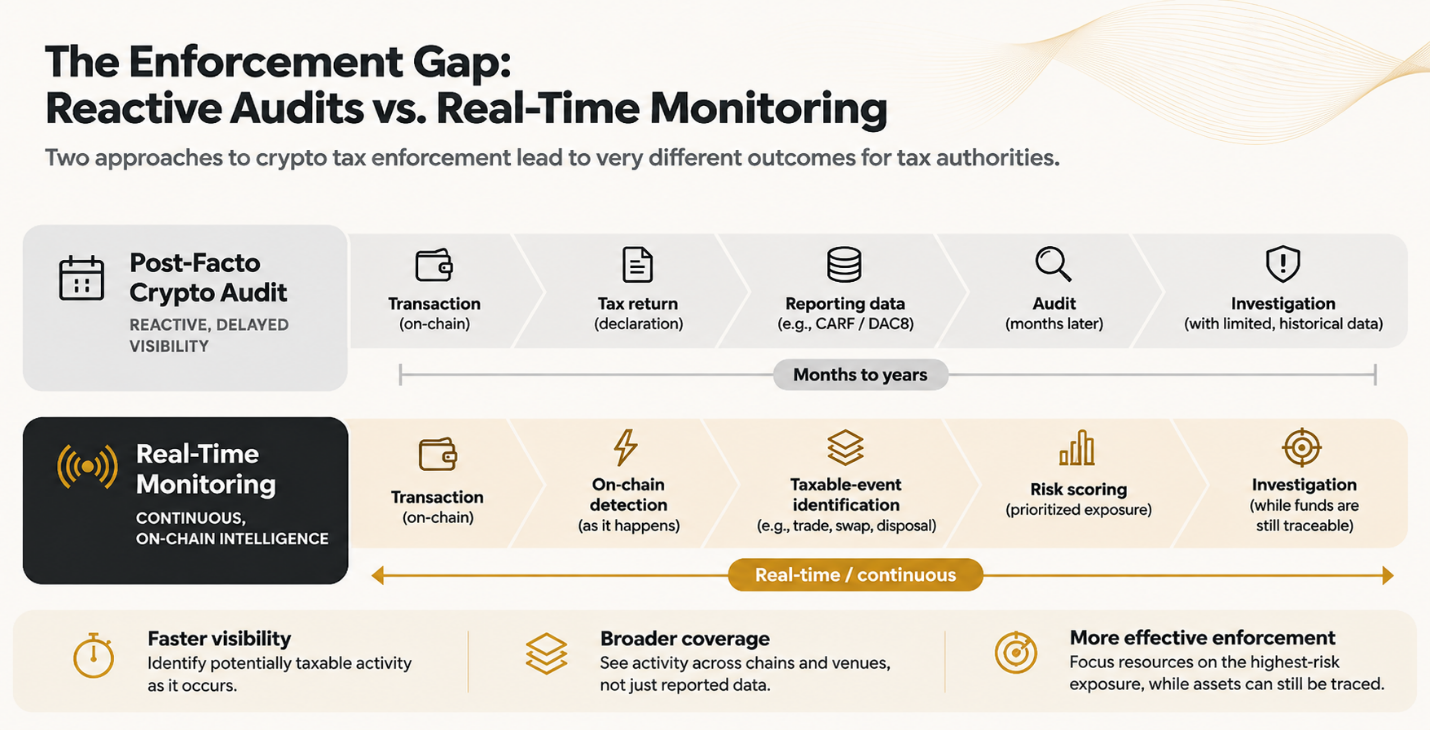
New reporting rules help, but they do not close the gap
The OECD’s Crypto-Asset Reporting Framework (CARF) and the EU’s DAC8 directive are important steps. Around 46–48 jurisdictions will begin CARF exchanges by 2027, and 27 more by 2028. The European Commission estimated that DAC8 alone would raise about €2.4 billion in additional revenue.
These rules still leave two gaps:
- Timing: DAC8 data collection began on 1 January 2026, but the first cross-border exchanges of that data are due by 30 September 2027. A trade made in January 2026 may reach a foreign tax authority about 21 months later.
- Coverage: reporting depends on intermediaries. Decentralized exchanges, self-custodied wallets and peer-to-peer transfers sit largely outside it. In the US, the rule that would have required DeFi platforms to report was repealed in 2025.
Reporting rules tell authorities what intermediaries saw, months after the fact. Everything else happens on-chain.
These remaining gaps in timing and coverage underscore why continuous, on-chain monitoring can complement intermediary reporting and close the visibility gap while assets remain traceable.
What real-time blockchain monitoring changes
Real-time monitoring turns the audit model around. Authorities stop waiting for declarations and returns, and instead watch taxable activity on the blockchain itself as it occurs.
- Continuous coverage: every relevant transaction is captured as it happens, across chains and venues, not sampled after the fact.
- Early detection: suspicious activity is flagged while assets can still be traced.
- Coverage: the Norwegian research concludes that enforcement must be “well-targeted” to be worth its cost. Real-time intelligence shows where the exposure is concentrated.
Introducing Archon Insights Taxable Events
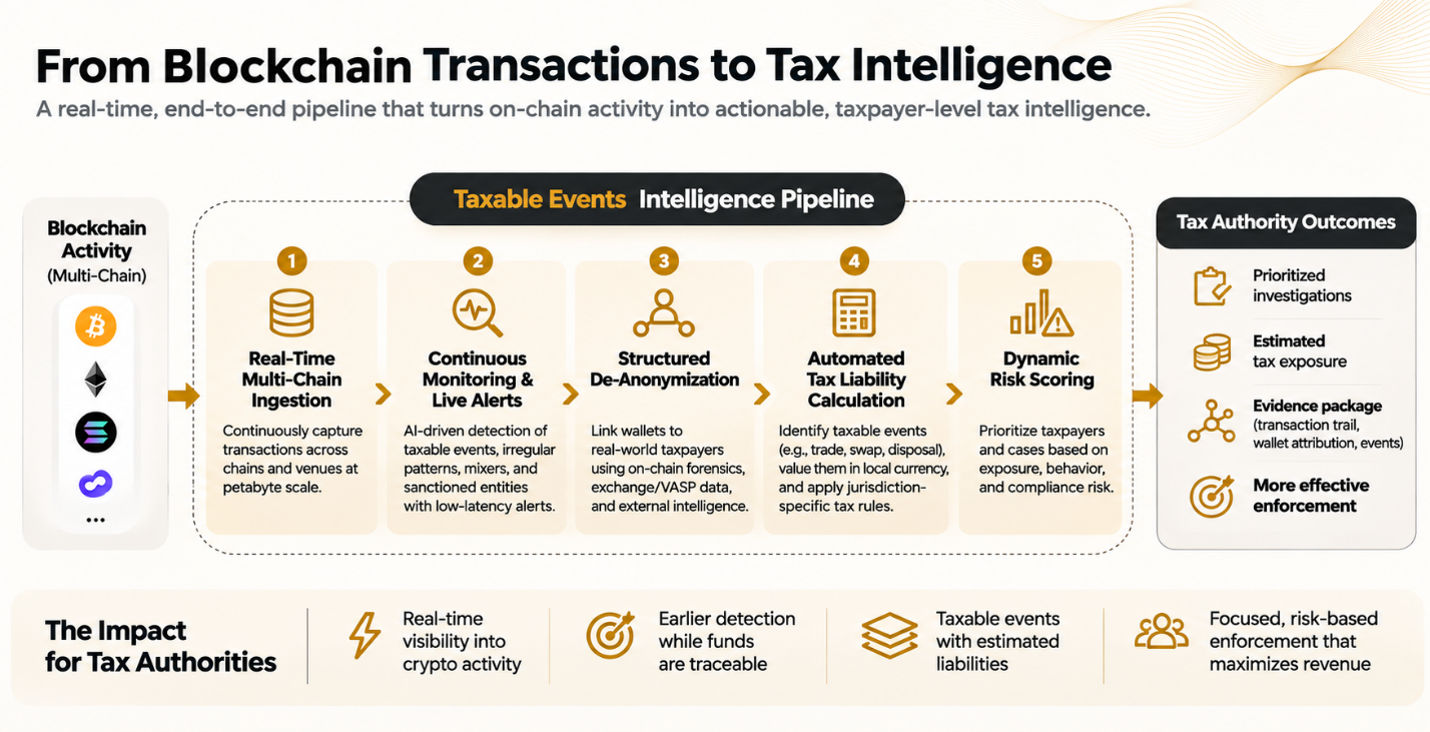
Archon Insights Taxable Events is built specifically for this shift. It turns raw blockchain activity into a continuous, real-time pipeline of de-anonymized, structured taxable events that tax authorities can act on directly.
How it works:
- Real-time, multi-chain ingestion: transactions are captured continuously as they are confirmed on-chain, on a petabyte-scale architecture that can quickly add new cryptocurrencies and asset classes.
- Continuous monitoring and live alerts: AI-driven algorithms scan activity as it lands. They identify taxable events and raise low-latency alerts on irregular trading patterns, illicit flows, mixer use and sanctioned entities, so investigators act while funds are still traceable.
- Structured de-anonymization: on-chain forensics is combined with exchange and VASP data and other external intelligence to link wallets to real-world taxpayers.
- Automated tax liability calculation: each taxable event is valued in local currency, and the rule sets can be updated as regulations change.
- Dynamic risk scoring: an AI-driven risk matrix updates as new activity arrives, so investigators always work the highest-value cases first.
Investigators also get:
- AI routines that detect evasion patterns, find undeclared wallets linked to known taxpayers, and expose trading connections between parties that seem unrelated
- Multi-hop transaction tracing to prove associations, accomplices and organized networks
- Alerts for suspicious tax submissions
- Forensic evidence packages to support audits and legal proceedings
- Natural-language business queries, such as “Show me the top five high-risk crypto taxpayers by region,” with custom dashboards for every stakeholder
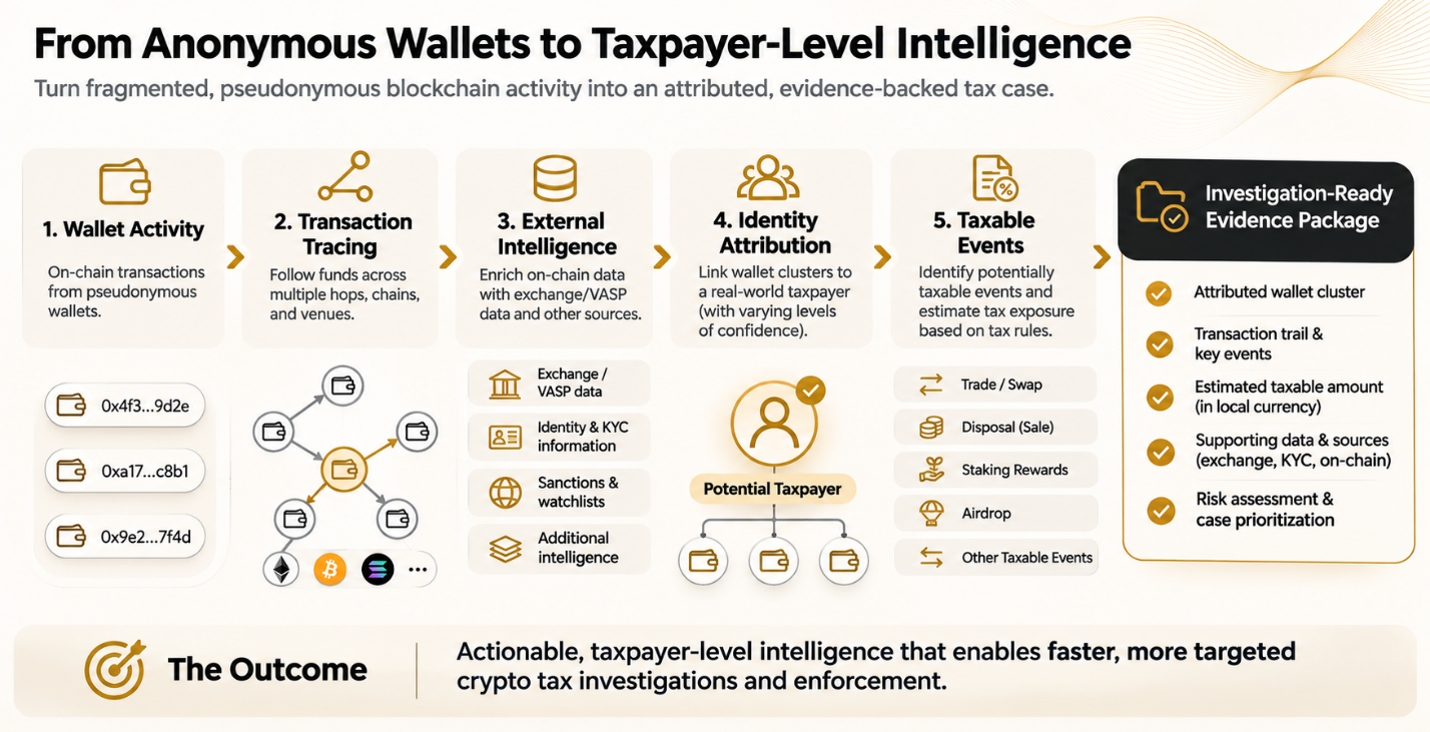
It is also available as a managed service, so authorities can start working on the crypto tax gap without building a specialist blockchain team from scratch.
Built on proven tax intelligence
Archon Insights builds on mLogica’s 20 years in complex data analytics. mLogica’s tax intelligence solutions already monitor tens of millions of transaction records a day in real time, helping authorities detect fraud and evasion as it happens. Archon brings the same real-time approach to digital assets.
From hindsight to foresight
Audits will remain an essential part of enforcement. In a market that runs around the clock and across borders, though, an audit that starts from incomplete data, long after the funds have moved, will always be behind. Tax authorities that monitor taxable crypto events in real time will collect revenue that others miss.
Want to see what taxable crypto activity looks like in your jurisdiction? Contact the Archon Insights team to request a demo or a crypto tax-gap assessment.
Sources
- IMF (2023).
- OECD Crypto-Asset Reporting Framework (2022).
- FATF Targeted Update on Virtual Assets (2025).
- Europol IOCTA (2026).
- European Commission, DAC8.
- Wilde & Menzer, Review of Accounting Studies (2026).
- Meling, Mogstad & Vestre, NBER WP 32865.
- Crypto.com Market Sizing Report (2026).
- HMRC FOI data (2026).
Suyash Singh – Product Manager - Analytics Solutions
- Share on


